Why More NYC Residents Are Choosing Doctor House Calls
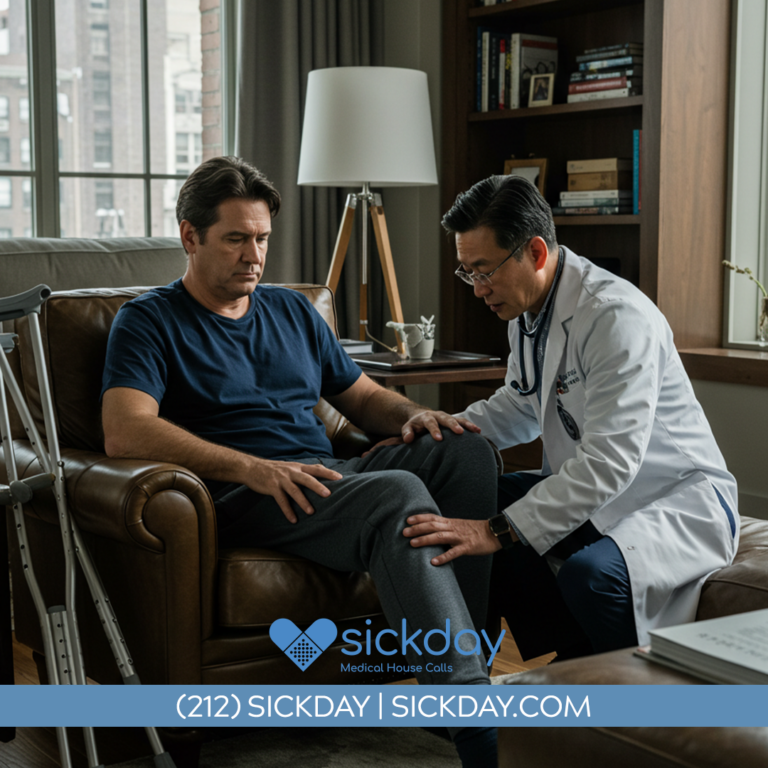
A doctor house call in New York City means a board-certified medical provider travels to your apartment, office, or hotel room to examine and treat you directly, rather than you traveling to a clinic. This model has grown because ER wait times, urgent-care lines, and the desire for privacy have made in-home doctor visits a practical alternative for acute illness across Manhattan, Brooklyn, Queens, the Bronx, and Staten Island.
Ask anyone who has sat in a Manhattan urgent care waiting room with a 102-degree fever and a room full of coughing strangers, and you’ll understand the appeal. Emergency rooms are built for trauma and life-threatening conditions, not for the ear infection keeping your toddler up at 2 AM or the strep throat that’s turned your voice into a whisper before a big presentation. Urgent-care centers help, but they come with parking hassles, waiting rooms, and the kind of fluorescent-lit efficiency that treats you as the next name on a list.
The shift toward doctor house calls in NYC isn’t a fad. Sickday has been sending board-certified physician assistants to New Yorkers’ doors for 17 years, treating more than 53,000 patients across all five boroughs, an average of roughly 3,100 patients treated per year. That track record exists because the underlying problem, being too sick to travel but not sick enough for an ambulance, has never gone away. What’s changed is that a reliable, fast, board-certified option now exists to meet it, available 8 AM to 9 PM, seven days a week, with a typical response time of 90 minutes or less from the moment you call.
How to Know If You Need a Home Doctor, Urgent Care, or the ER
Choosing between an in-home doctor visit, urgent care, and the emergency room depends on symptom severity. Non-emergency issues like sore throats, UTIs, fevers, and minor injuries are appropriate for primary care or house-call providers. Moderate but time-sensitive conditions fit urgent care. True emergencies, chest pain, difficulty breathing, severe bleeding, require 911 or the ER immediately.
Private Medical Physicians (PPMCO) advises that your primary care doctor, or an equivalent in-home provider, is the right first call for sprains and strains, minor cuts and burns, colds and coughs, fevers, and rashes. These are conditions that need attention but not a trauma bay. Blue Cross Blue Shield’s guidance draws a similar line for urgent care: colds, flu, earaches, eye pain, sore throat, and minor cuts or burns are moderate issues that need timely, in-person evaluation but don’t require the resources of an emergency department.
The 911/ER category is reserved for genuine emergencies: chest pain, stroke symptoms, severe trauma, uncontrolled bleeding, or loss of consciousness. If you’re unsure whether you’re in that category, err toward calling 911. For everything short of that, a doctor house call often gets you seen faster and more comfortably than either alternative, typically within that same 90-minute window.
| Care Setting | Best For | Typical Wait |
|---|---|---|
| Home Doctor Visit | Strep, UTI, flu, pink eye, fevers, minor injuries | 90 minutes or less |
| Urgent Care | Similar conditions when you can travel and don’t mind a waiting room | Often 1-3 hours in-person |
| Emergency Room | Chest pain, stroke symptoms, severe trauma, uncontrolled bleeding | Variable, prioritized by acuity |
Once you’ve placed your symptoms in the home-doctor column, the next step is simple: call and get a provider moving toward you instead of the other way around.
Ready for a doctor to come to you? Board-certified PAs cover all five boroughs, 8 AM, 9 PM, seven days a week.
Understanding Your Insurance: PPO, HMO, and In-Network Lookup Tools
PPO plans let members see out-of-network providers without a referral, usually at a higher cost-share, giving PPO holders more flexibility to book at-home care. HMO plans generally require staying in-network and often need referrals. New York State offers an official lookup tool to confirm whether a specific provider is in-network before you book.
The federal definition, per the CDC’s National Center for Health Statistics, describes a PPO as coverage through a network of selected providers where enrollees may still seek care outside that network, paying a greater share of the cost themselves. That flexibility matters here: if you’re a PPO holder, you already have the built-in option to see an out-of-network provider like a house-call PA and submit for partial reimbursement, no referral required, per Healthcare.gov’s plan-type guidance.
HMO plans work differently. They typically restrict you to an in-network provider list and require a primary care referral for most specialist care, which makes spontaneous, same-day house calls harder to arrange under that plan structure. If you want to check a provider’s network status directly, the New York State Department of Health’s Provider & Health Plan Look-Up Tool lets you search doctors, facilities, and health plans to confirm in-network standing before you commit to an appointment.
The simpler path: Sickday charges a flat $430 fee per visit, no network lookup, no referral, no guessing what your cost-share will be. PPO holders can often submit the visit for out-of-network reimbursement afterward. Sickday does not accept Medicare.
If the idea of cross-referencing a provider directory while you’re running a fever sounds exhausting, that’s the exact friction a flat-fee model is built to remove. You call, you’re quoted one number up front, $430, and the insurance paperwork becomes something you deal with later, not a gate you have to clear before getting help.
What Actually Happens When a Doctor Comes to Your Home
A Sickday home visit starts with a phone call to book, followed by a board-certified physician assistant arriving at your location, typically within 90 minutes. The visit includes a physical exam, diagnosis, and treatment on the spot, which may include prescriptions, point-of-care testing, or referral guidance, all delivered where you already are, anywhere in the five boroughs, between 8 AM and 9 PM, seven days a week.
This is meaningfully different from telehealth. A video call can assess some symptoms, but it can’t listen to your lungs, swab your throat, check your ears with an otoscope, or run a rapid strep or flu test. A physical exam catches things a camera misses, an ear that looks fine on video but is clearly infected under an otoscope, or a rash that needs to be felt to be properly assessed. When you book a house call, you’re getting the physical diagnostic tools of an urgent-care visit without leaving your bed.
The provider who arrives is board-certified and equipped to treat you at the point of care. That means many visits end with medication in hand or a prescription sent electronically to your pharmacy, not a referral slip telling you to go somewhere else and start the process over. For people managing a fever, a toddler with an ear infection, or a business trip derailed by strep throat, that single-visit resolution is the entire value proposition of an in-home doctor.
Common Conditions Treated By In-Home Doctors in NYC
In-home doctors in NYC commonly treat strep throat, urinary tract infections, pink eye, swimmer’s ear, flu, colds, minor injuries, and similar acute conditions that don’t require emergency care but do need prompt, in-person diagnosis and treatment, consistent with the moderate-acuity conditions described in Blue Cross Blue Shield’s care-setting guidance.
- Strep throat and other sore-throat infections, confirmed with rapid testing on-site
- Urinary tract infections, with symptom relief and antibiotics prescribed the same visit
- Pink eye (conjunctivitis), which spreads fast in households and offices and benefits from quick diagnosis
- Swimmer’s ear and other ear infections, especially painful and disruptive in children
- Flu and cold symptoms, including fever management and testing when appropriate
- Minor cuts, burns, sprains, and other injuries that don’t require an ER but need attention
- Gastrointestinal illness, dehydration, and general acute malaise that make travel unrealistic
These are exactly the conditions PPMCO and BCBS point to as appropriate for primary-care-level, in-person treatment rather than emergency services. Across roughly 53,000 patient visits over 17 years, this is the mix of acute, non-emergency conditions Sickday’s providers see most often. The difference with a house call is that the treatment comes to the patient instead of the patient dragging themselves, or a sick child, across the city to get it.
Hotel Guests and Business Travelers: Getting a Doctor to Your Room
Hotel guests and business travelers in Manhattan can book an in-home doctor visit directly to their hotel room, with no need to locate a local clinic, navigate an unfamiliar insurance network, or leave the property. A board-certified provider arrives with the same exam and treatment capability as a home visit, typically within 90 minutes.
Getting sick in a hotel room in a city you don’t live in is its own particular kind of stressful. You don’t know which urgent-care clinic to trust, your travel insurance situation is unclear, and the concierge desk can only do so much. A hotel doctor visit solves this cleanly: you call, give your hotel address and room number, and a provider comes to you, no rental car, no rideshare to an unfamiliar clinic, no explaining your symptoms twice.
This matters for business travelers especially. A conference keynote or an investor meeting doesn’t pause because you woke up with a 101-degree fever. Getting treated in your room, diagnosed, and often started on medication within the same day frequently means the difference between salvaging a trip and losing it entirely. Sickday’s coverage spans all five boroughs, which includes the Manhattan hotel corridors most business travel concentrates around, at the same 8 AM, 9 PM, seven-day availability and roughly 90-minute response time as residential visits.
What It Costs, and Why Flat-Fee Beats Insurance Guesswork
Sickday charges a flat $430 fee per home visit, covering the exam, diagnosis, and on-site treatment, with no network restrictions, referrals, or surprise billing. This differs from urgent-care or ER visits, where costs vary by facility, insurance status, and services rendered, and where out-of-network care can result in unpredictable bills after the fact.
Emergency room bills are notorious for arriving weeks later with line items nobody explained in the moment: facility fees, separate physician fees, lab charges billed individually. Urgent care is more predictable but still runs through your insurer’s network rules, and if you accidentally walk into an out-of-network location, you’re exposed to the same guesswork PPO plans are designed to buffer, just without knowing the number ahead of time. A single flat $430 fee, quoted before the provider is even dispatched, replaces all of that uncertainty with one known figure.
The flat-fee math: $430 covers the full home visit, exam, diagnosis, and treatment. No network lookup, no referral, no separate facility and physician billing. PPO holders can submit for out-of-network reimbursement afterward if their plan allows it. Sickday does not accept Medicare.
For a PPO holder who already has out-of-network flexibility, the flat fee simply converts a variable, hard-to-predict cost-share into one fixed number you know before the provider ever knocks. For anyone who’d rather not think about insurance at all while they’re sick, it removes the decision entirely.
How to Book a Doctor to Come to Your Home Today
Booking a Sickday house call takes one phone call. Provide your location, symptoms, and preferred timing, and a board-certified PA is dispatched to your home, office, or hotel across any of the five boroughs, typically arriving within 90 minutes, available 8 AM to 9 PM, seven days a week.
There’s no app to download and no portal to create an account on while you’re running a fever. You call, describe what’s going on, and someone experienced on the other end helps you decide, calmly, whether a house call is the right move (it usually is, for exactly the conditions this article has walked through). Then a provider gets moving toward you.
People who’ve used the service tend to describe the same moment of relief: the knock on the door, the quick exam, and the realization that they didn’t have to get dressed, find a cab, or sit in a waiting room to get real medical care. That’s the entire point of the in-home doctor model, treatment that meets you where you already are, from a board-certified provider qualified to actually resolve the problem in one visit, one of thousands added each year to Sickday’s 53,000-and-growing patient count.
Too Sick to Leave? We’ll Come to You.
Board-certified PAs, all five boroughs, 8 AM, 9 PM, seven days a week, typically within 90 minutes.
Frequently Asked Questions
Is it really possible to get a doctor to come to my home in NYC the same day?
Yes. Services like Sickday dispatch board-certified physician assistants to homes, offices, and hotels across all five boroughs, typically arriving within 90 minutes of booking. Availability runs 8 AM to 9 PM, seven days a week, making same-day, in-person treatment realistic for most acute, non-emergency conditions.
How is a house call different from a telehealth video visit?
A house call includes an in-person physical exam, such as listening to lungs, checking ears with an otoscope, or performing rapid strep and flu testing, none of which a video call can replicate. Telehealth is useful for simple consultations, but conditions requiring hands-on diagnosis or point-of-care testing generally need an in-person provider.
How do I know if I need a home doctor, urgent care, or the ER?
Non-emergency conditions such as sore throat, fever, UTI, minor cuts, or rashes are appropriate for a home doctor or primary care visit, per guidance from PPMCO and Blue Cross Blue Shield. Urgent care suits similar moderate conditions when travel is possible. True emergencies, chest pain, severe bleeding, difficulty breathing, require 911 or the ER immediately.
Will my insurance cover an in-home doctor visit?
PPO plans generally allow members to see out-of-network providers without a referral, at a higher cost-share, per Healthcare.gov and CDC/NCHS guidance. HMO plans typically restrict coverage to in-network providers. Some services, including Sickday, use a flat $430 fee instead, letting PPO holders submit for out-of-network reimbursement without needing pre-verified network status.
Does Sickday accept Medicare?
No. Sickday operates on a flat-fee model and does not accept Medicare. The service is designed for PPO holders, self-pay patients, and anyone who prefers a fixed, upfront cost over navigating insurance networks, which differs from Medicare’s provider-directory-based system such as the Care Compare tool run by CMS.
Can hotel guests or business travelers book a home doctor visit?
Yes. Hotel guests and business travelers in Manhattan and across the five boroughs can book an in-home doctor visit directly to their hotel room. The provider brings full exam and treatment capability to the room, removing the need to locate an unfamiliar local clinic or navigate a foreign insurance network while traveling.
What conditions can an in-home doctor actually treat?
In-home providers commonly treat strep throat, urinary tract infections, pink eye, swimmer’s ear, flu, colds, minor injuries, and similar acute conditions. These align with the moderate-acuity conditions Blue Cross Blue Shield and PPMCO identify as appropriate for primary-care-level, in-person treatment rather than emergency services.
Sources
- New York State Department of Health, “NYS Provider & Health Plan Look-Up Tool”
- Medicare.gov (Centers for Medicare & Medicaid Services), “Find Healthcare Providers: Compare Care Near You”
- Healthcare.gov (Centers for Medicare & Medicaid Services), “Health Insurance Plan & Network Types: HMOs, PPOs, and More”
- CDC/NCHS, “Preferred Provider Organization (PPO),” Health, United States, 2023
- Blue Cross Blue Shield, “When to Visit: Primary Care, Urgent Care or Emergency Room?” 2025
- Private Medical Physicians (PPMCO), “Find Care Now,” 2025
Read Our Related 2026 Pillar Guides
- What Is Sickday? NYC House Calls & Telemedicine Guide
- Sickday Care Types: House Calls, Telemedicine, IV Therapy
- Choosing Concierge Healthcare in NYC